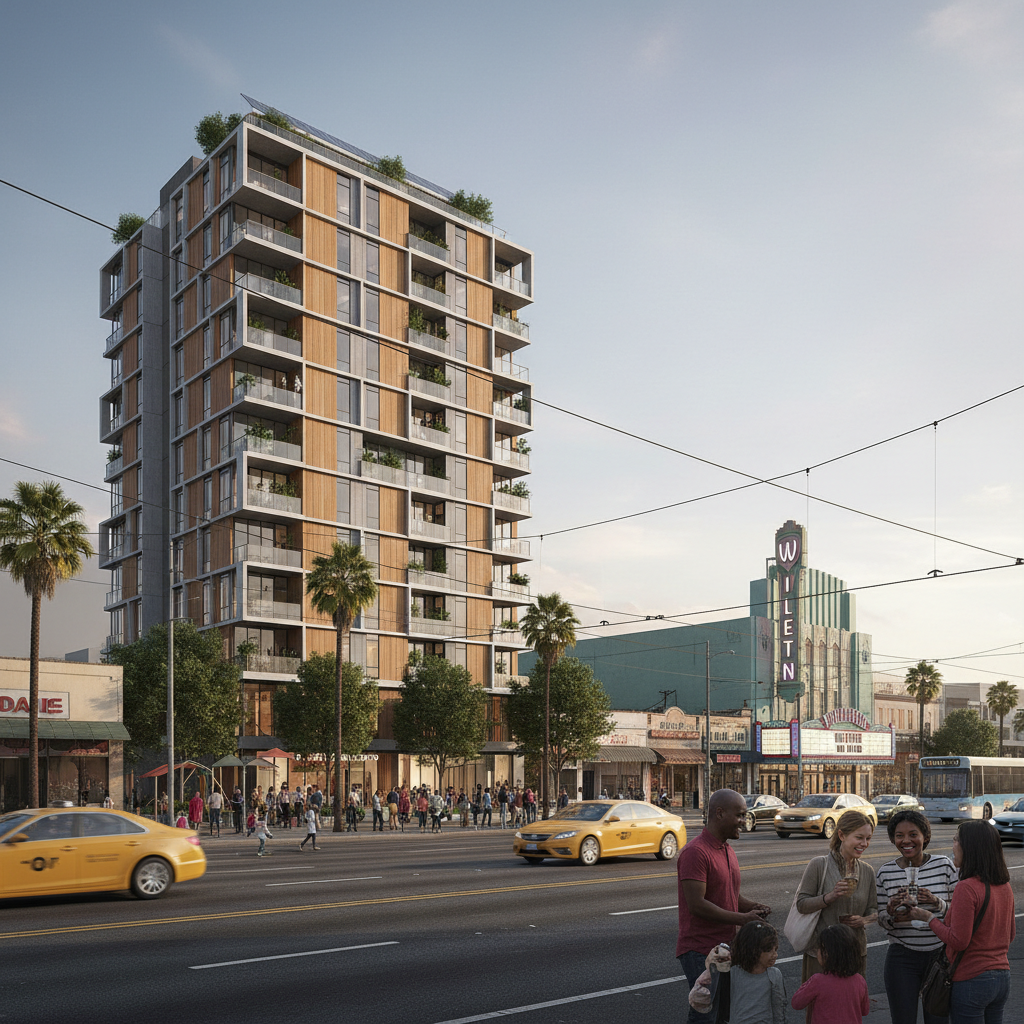
The Los Angeles City Planning Commission has given final approval for a 15-story, 100% affordable housing development at 3700 Wilshire Boulevard in Koreatown. This project will provide 220 units for low-income seniors and families, addressing a critical need in the densely populated neighborhood.
The 'Wilshire Community Homes' project, spearheaded by the non-profit developer Abode Communities, received unanimous approval from the City Planning Commission yesterday. Located on a currently vacant lot adjacent to the historic Wiltern Theatre, the development will feature 220 units, all designated for households earning between 30% and 60% of the Area Median Income (AMI). This includes 50 units specifically for formerly homeless individuals and families.
'This approval is a monumental step forward in our fight against the housing crisis,' stated John Maceri, CEO of Abode Communities. 'Koreatown is one of the most vibrant and diverse neighborhoods in LA, but it's also one of the most expensive. Projects like Wilshire Community Homes ensure that our seniors, essential workers, and families can continue to live and thrive here.' The project is expected to break ground in Q4 2026, with a projected completion in early 2029.
The development will include extensive on-site amenities, such as a community room, computer lab, fitness center, and a landscaped rooftop deck. Ground-floor retail space is also planned, which will provide local services and employment opportunities. Funding for the $110 million project comes from a combination of state low-income housing tax credits, city bond funds, and private philanthropic contributions.
Local community groups, including the Koreatown Immigrant Workers Alliance (KIWA), have been strong advocates for the project. 'We've seen too many long-time residents pushed out due to rising rents,' said Grace Yoo, a KIWA representative. 'This development offers a lifeline and a promise that Koreatown remains a place for everyone.' The project's proximity to public transit, including the Wilshire/Western Metro station, was a key factor in its approval, aligning with the city's transit-oriented development goals.